The relation instrumentalists have with their physical body is of a
particular kind. Their body is substituted by the instrument, at least
during the performance. All the muscles, the nervous system is dedicated
to make this weird keys and holes system that we call a clarinet obey
to the sound image the performer wants to transmit.
When this practice lasts for years, to ask a musician to take the instrument out and express him or herself without, is a source of serious difficulties.
As a retired cellist i´ve always considered the instrument to be part of the chain which doesn´t make music but more surely keeps us encapsulated in the net and the chains of duty, control, and conventions (a certain idea of beauty, a repertoire, orchestras, etc.).
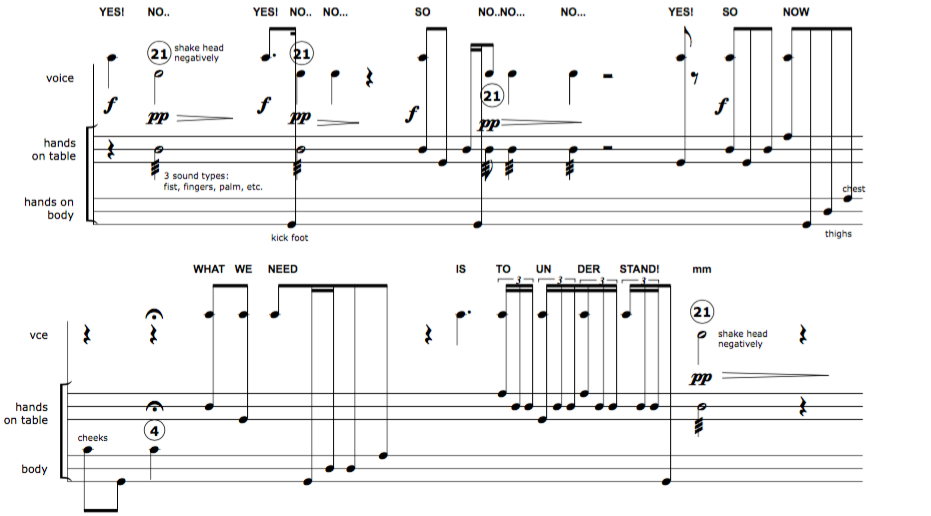
It doesn t mean that using the body to produce music necessarily goes into either the direction of Bobby mc Ferrin (substituting the sound of the instruments by the ones of the body) or dance. The body can express many sound activities, either while producing sound, or by the memory of it. By memory i mean that some gestures convey some sounds even if they are produced in silent. Our memory reconstitutes the absent sound. And this effect is of the same nature and importance than the dissociation of the sound and its source provided by the loudspeaker. It is an abstraction, an opening towards broad interpretation, and the substrat for layering and constructing a work.
For that reason i would like to insist on the perversion and the highly problematic usual denominations “music”, “theatre”, “music theatre”, “performance”. I know like everybody else the reasons and the usefulness of these terms, and i´m not claiming the need for a new one. But they are terribly misleading because they isolate phenomenons, an isolation which doesn´t belong to us. I think we are generally analogic in our interpretations, and synesthesic in our perceptions. The example of the memory of the sound given by the look, the example of the instrument that we visualise when we hear its recording shows (among thousands) that our life is entirely depending on this supreme faculty: associating, reflecting, reverberating impressions, perceptions, consciously or not. It has nothing to do with one special field.
The separation of activities, already theorised by Plato, and then generalised in our every day life certainly is part of the source of these conception. “ You shall do one thing only, for the sake of the City”. The ancient idea of the poet, who sings, composes, writes texts and carries the divine voice is pulled back to earth by the social and economic regulations. In other cultures, like central Africa or Thailand, the artistic practice is not reserved to the specialists but can be part of everyday´s life, mixing the sacred, the decorative with the functional and the useful aspects of life.
This synesthesic approach, where our senses and our memory are sollicitated without distinction is certainly a completely underestimated one, even in art.
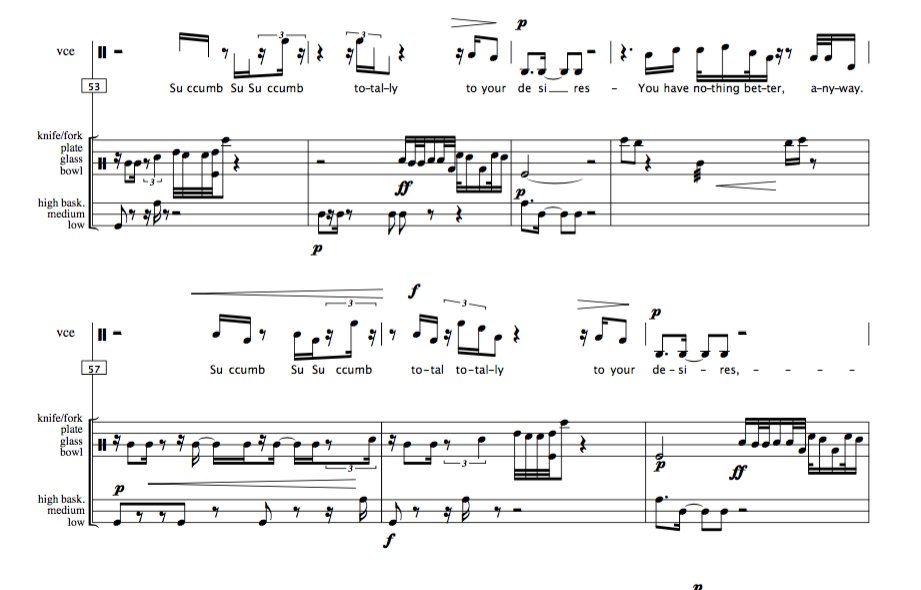
I´ve been experiencing these ideas in a series of short pieces, called Situations. These pieces use one or two found phrases (slogans, proverbs, aphorisms), a certain physical configuration (one, two three performers), a space (chair, table or nothing, preferably nothing), and use a very traditional notation that can be read by music beginners. They can be performed in any language, with no gender, age etc. considerations.
They float between music, theatre, music theatre, performance, actions, rituals. But they all have in common the importance given to the gestures, the net of significations deployed by them. The different layers (text, situation, gestures) are not necessarily consistent, which connects to the absurdist theatre of the 60´s, with a possible comical effect. However, the musical notation keeps them in a different shape, or texture than the one of theatre, which is the time order: the set of actions is musically organised.
Useless to say that these little pieces (although they are very successful among musicians) still have difficulties to find their perfect performers: a lot of musicians have difficulties to give up with their instrument (their transitional object). Opening the borders of music towards these crossed perceptions (involving maybe the eyes, or the smell, the touch) requires an absence of specific in one specific domain. One must be able to give up with a lot of excellence references in order to find the fine tuning between the fields of action, voice, action, rhythm.
These Situations are very small, very short, and confidential (for a very limited audience and small amount of performers), but i keep looking at them as one of the keys to unlock our categories, our limitations and our absence of bodies.
françois sarhan, feb. 2016
When this practice lasts for years, to ask a musician to take the instrument out and express him or herself without, is a source of serious difficulties.
As a retired cellist i´ve always considered the instrument to be part of the chain which doesn´t make music but more surely keeps us encapsulated in the net and the chains of duty, control, and conventions (a certain idea of beauty, a repertoire, orchestras, etc.).
It doesn t mean that using the body to produce music necessarily goes into either the direction of Bobby mc Ferrin (substituting the sound of the instruments by the ones of the body) or dance. The body can express many sound activities, either while producing sound, or by the memory of it. By memory i mean that some gestures convey some sounds even if they are produced in silent. Our memory reconstitutes the absent sound. And this effect is of the same nature and importance than the dissociation of the sound and its source provided by the loudspeaker. It is an abstraction, an opening towards broad interpretation, and the substrat for layering and constructing a work.
For that reason i would like to insist on the perversion and the highly problematic usual denominations “music”, “theatre”, “music theatre”, “performance”. I know like everybody else the reasons and the usefulness of these terms, and i´m not claiming the need for a new one. But they are terribly misleading because they isolate phenomenons, an isolation which doesn´t belong to us. I think we are generally analogic in our interpretations, and synesthesic in our perceptions. The example of the memory of the sound given by the look, the example of the instrument that we visualise when we hear its recording shows (among thousands) that our life is entirely depending on this supreme faculty: associating, reflecting, reverberating impressions, perceptions, consciously or not. It has nothing to do with one special field.
The separation of activities, already theorised by Plato, and then generalised in our every day life certainly is part of the source of these conception. “ You shall do one thing only, for the sake of the City”. The ancient idea of the poet, who sings, composes, writes texts and carries the divine voice is pulled back to earth by the social and economic regulations. In other cultures, like central Africa or Thailand, the artistic practice is not reserved to the specialists but can be part of everyday´s life, mixing the sacred, the decorative with the functional and the useful aspects of life.
This synesthesic approach, where our senses and our memory are sollicitated without distinction is certainly a completely underestimated one, even in art.
I´ve been experiencing these ideas in a series of short pieces, called Situations. These pieces use one or two found phrases (slogans, proverbs, aphorisms), a certain physical configuration (one, two three performers), a space (chair, table or nothing, preferably nothing), and use a very traditional notation that can be read by music beginners. They can be performed in any language, with no gender, age etc. considerations.
They float between music, theatre, music theatre, performance, actions, rituals. But they all have in common the importance given to the gestures, the net of significations deployed by them. The different layers (text, situation, gestures) are not necessarily consistent, which connects to the absurdist theatre of the 60´s, with a possible comical effect. However, the musical notation keeps them in a different shape, or texture than the one of theatre, which is the time order: the set of actions is musically organised.
Useless to say that these little pieces (although they are very successful among musicians) still have difficulties to find their perfect performers: a lot of musicians have difficulties to give up with their instrument (their transitional object). Opening the borders of music towards these crossed perceptions (involving maybe the eyes, or the smell, the touch) requires an absence of specific in one specific domain. One must be able to give up with a lot of excellence references in order to find the fine tuning between the fields of action, voice, action, rhythm.
These Situations are very small, very short, and confidential (for a very limited audience and small amount of performers), but i keep looking at them as one of the keys to unlock our categories, our limitations and our absence of bodies.
françois sarhan, feb. 2016